Glaucoma is a group of progressive conditions of the visual pathway, including the visual cortex, marked by continuous loss of the visual field over time.
Glaucoma is multifactorial, brought about by a number of causes: raised intraocular pressure, vascular factors, the use of certain medicines, genetic predisposition, states following injury or surgery, systemic disease, tumours and more.
Most current treatment for glaucoma focuses on lowering intraocular pressure and on supporting the function and structure of the nervous system responsible for vision. You can read about the new glaucoma treatment available in Slovakia only at Viziocum elsewhere on this site.
While intraocular pressure is certainly a risk factor, the progression of glaucoma is also linked to reduced blood supply, since progression sometimes occurs even at normal eye pressure. Research confirms that glaucoma progresses as a result of reduced blood flow within the eye, once compensatory or alternative blood supply ceases to work. There is no doubt that raised or unstable eye pressure contributes to a reduced blood supply and to the ischaemic damage that follows, creating a vicious circle that provokes further damage and progressive loss of sight.
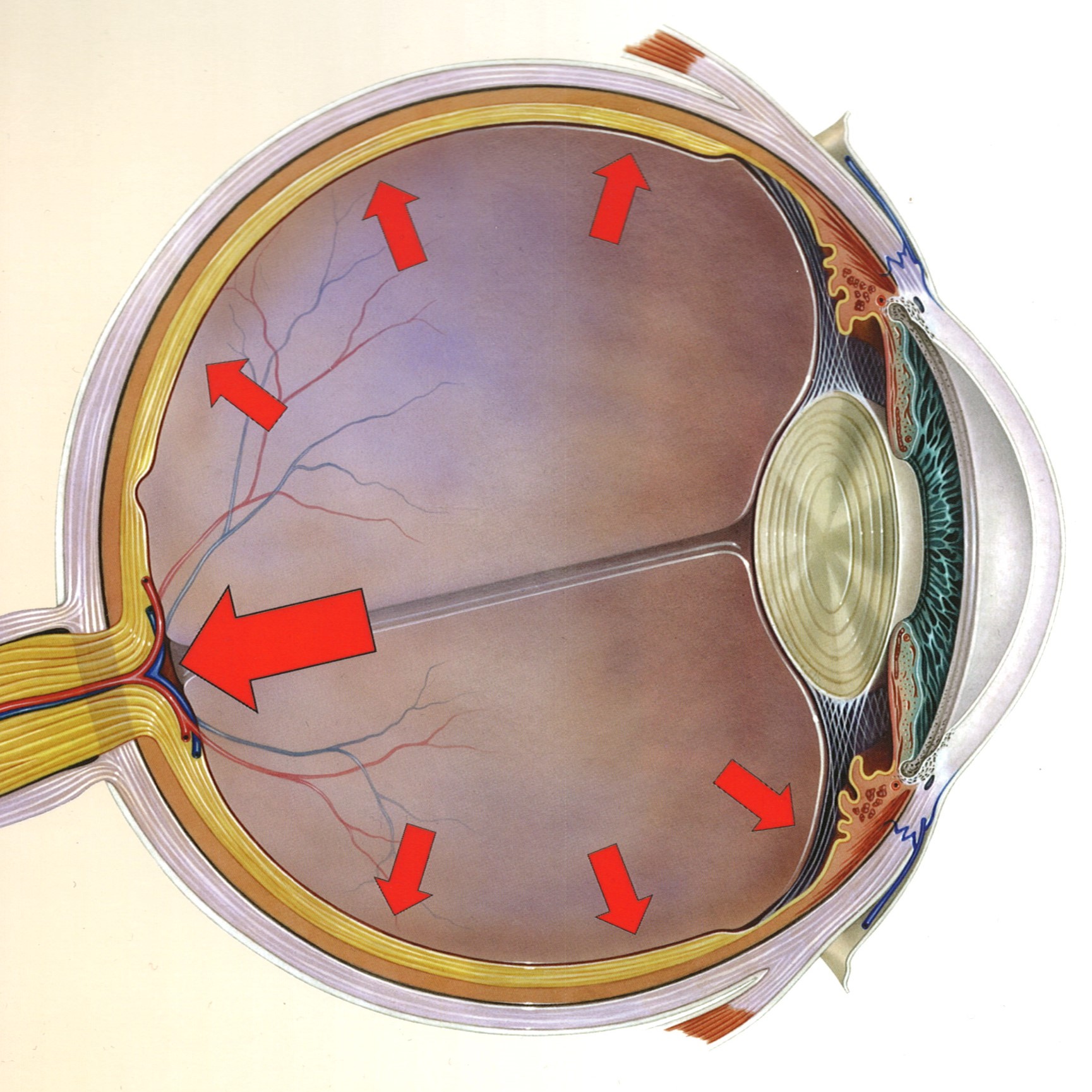
The optic nerve is vulnerable to fluctuations in ocular blood flow. Low blood pressure may play a more significant role in the progression of glaucoma than high intraocular pressure.
Besides disproportionate eye pressure, the risk factors for developing glaucoma include advancing age, ethnicity, high myopia, a thin central corneal thickness, a family history of glaucoma — particularly in first-degree relatives — sleep apnoea, and the systemic vascular damage mentioned above.
Glaucoma is diagnosed through routine eye examinations: measurement of eye pressure, visual acuity, ophthalmoscopy (assessment of the optic nerve), perimetry (visual field testing), gonioscopy (examination of the drainage angle) and optical coherence tomography (modern scans that measure the thickness of the nerve fibre and ganglion cell layers).
The absence of ocular symptoms, especially where glaucoma advances slowly, is masked by the plasticity of the brain, because the brain compensates for the reduced visual signal. A further explanation is the phenomenon of becoming accustomed to a slow deterioration in sight that develops and progresses over an extended period. This is probably why people affected by glaucoma rarely complain of losing their sight, and do not regard worsening vision as a "sight-threatening symptom". Symptoms at the middle stage of glaucoma include increased sensitivity to light, reduced night vision, mild to moderate "clouded" or "misty" vision, and a feeling of pressure behind the eyes.
At advanced stages patients undeniably begin to notice the symptoms of a narrowed peripheral field, which often leads to difficulty finding their way around an unfamiliar room or space. Patients may walk into walls and objects and trip while walking. At this point, alongside the "misty" vision, they also experience intense glare and markedly reduced vision in poorly lit surroundings. Tragically, the final stage of glaucoma leads to a substantial reduction in central vision and ultimately to blindness.
Magnetic resonance imaging of the brain shows that patients with glaucoma have focal brain damage in areas beyond the occipital lobe, the retina and the optic nerve. Remarkably, structural changes have even been observed in non-visual regions of the brain. New evidence is emerging that patients with glaucoma also show atrophy of the amygdala — the part of the brain responsible for emotion and memory. Such abnormalities of the amygdala may explain why people affected by glaucoma often experience mood instability, heightened anxiety, increased fear and feelings of anger. Glaucoma, then, is not a disease of the eye alone but of the brain as well.