Treating vision with electrostimulation
Hope for patients with low vision
Our clinic in Banská Bystrica offers a treatment that is the first of its kind in Slovakia. It is electrostimulation, and it gives hope to patients with low vision caused by glaucoma or other damage to the optic nerve, to patients diagnosed with retinitis pigmentosa, with traumatic injury to the visual pathway, or with visual function weakened after Covid.
Sight is not only the product of the neural function of the eye itself; low vision has a great deal to do with the brain. Visual impairment caused by damage to the optic nerve and the visual pathway need not always be permanent. Not all nerve cells have died. Some of them merely have weakened function, and in those cases it is possible to attempt to activate such cells. These so-called hypometabolic neurons — not active enough to generate nerve impulses, yet still alive — can be reactivated by electrostimulation: vascular circulation improves and with it the functioning of the neurons.
The eyes do not work in isolation; many other organs influence them, such as the brain and the vascular system. When information travels from the eye to the brain it has to be processed by nerve tissue. The nerve tissue of the eye weighs 1.2 g, while the brain tissue needed to process visual information weighs 300 grams.
Visual information is distributed throughout the brain. Brain waves produced by nerve activity, which runs in cycles, oscillate, and the activity of the various regions of the brain needs to be synchronised.
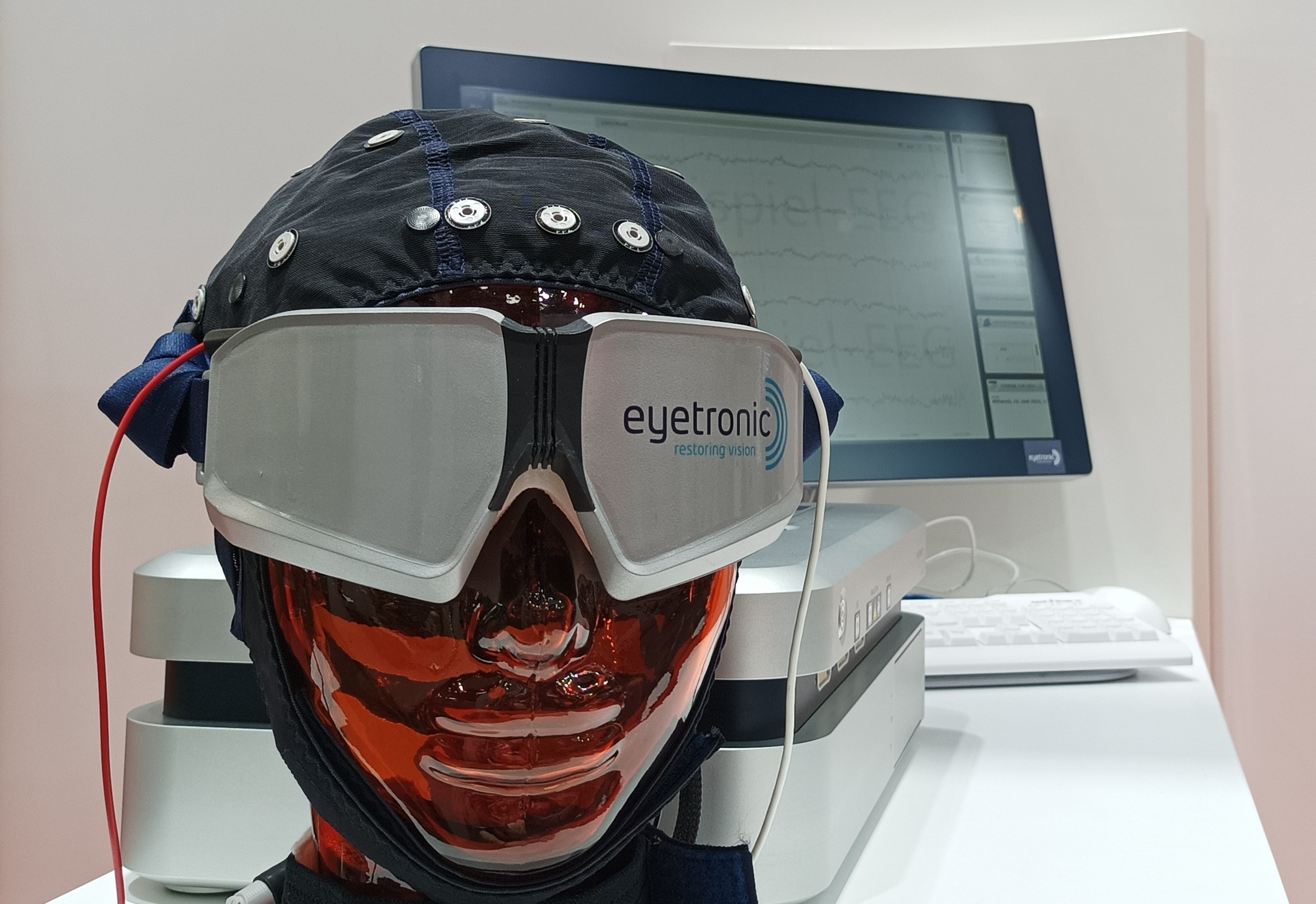
To achieve that synchronisation, the treatment uses a stimulator applied through non-invasive electrodes simply placed on the scalp. Treatment lasts 10 days and uses a microcurrent that travels along the visual pathway as far as the occipital lobe, where the cortical centre of vision is located.
+
The effect of the treatment varies between patients. It may be greater, smaller, or even absent. Some patients achieve an improvement of 30–100 %. Most patients achieve an improvement of 20 %.
The treatment has no side effects. The maximum effect is reached 6–12 weeks after treatment. The neurons learn how to transmit signals again and carry on doing so, unless the brain decides to "switch them off" once more, which is rare.
The treatment may be repeated after an interval of 9 months.